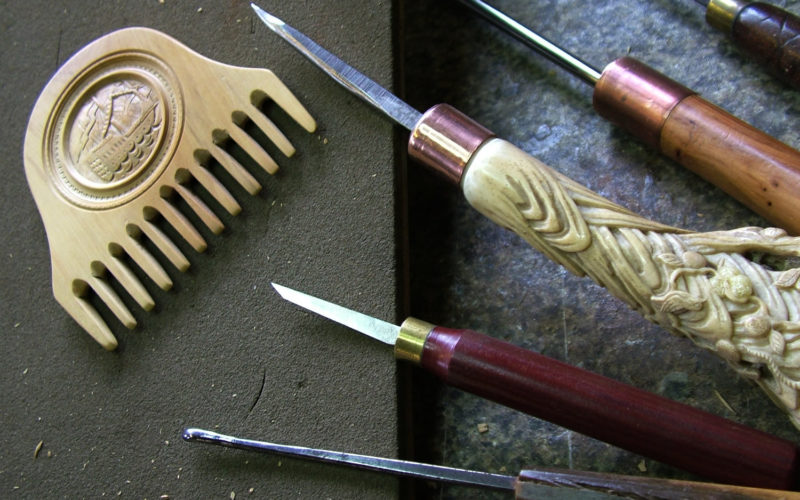
Wassailing is an ancient English tradition that is said to go back as far as Saxon and Viking times. The word ‘wassail’ comes from the Old English “Waes hael” meaning “Good Health”, to which the response would be “Drinc hael, and drinking was at the heart of wassailing. The tradition has always varied from manor to manor, from monastery to guild and street to street where wassailing latter became part of house to house carolling during Christmas tide. Continue reading
Tag Archives: Woodturning
Romanian bow lathe
In 1998 I was privileged to visit the Constantin family in Romania to film the making of drop spindles from lime wood (linden) on a primitive bow lathe.
Making a spinning top on a pole lathe
Robin Fawcett demonstrates how to make a spinning top on a pole lathe. An ash log is riven into quarters, using a maul and froe. It’s cut to length with a pull saw and shaped with a side axe, before being put in the pole lathe…
Gary Rance Round Skew
Master production woodturner Gary Rance demonstrates the use of his round skew. This is available to buy from www.garyrance.co.uk.
Yasuhiro Satake, Japanese woodturner
Yasuhiro entertained delegates at the 2009 AWGB seminar with his unusal (to us in the west) turning techniques and tools. It is always good to experience the craft skills of other cultures from which we can often learn a great deal.
Moroccan bow lathe turner
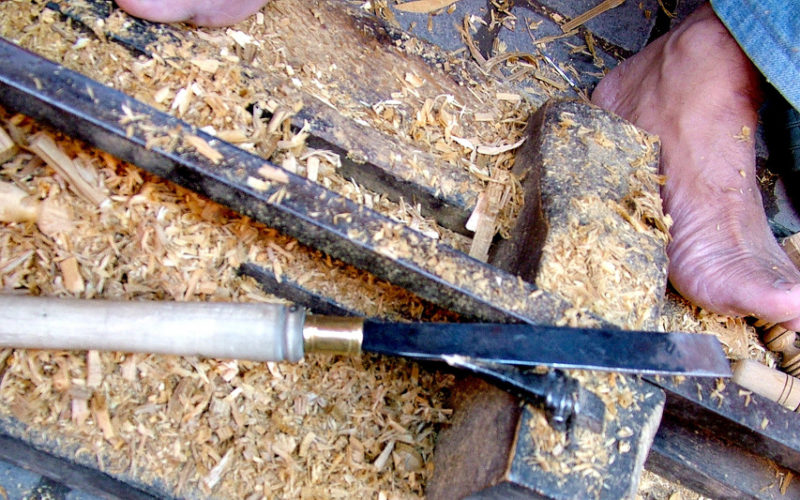
This young woodturner can be found plying his trade in the medina of old Marrakech. With just one tool (a skew chisel) he turns a chess piece on a bow lathe that would have been a familiar sight in ancient Greece or the Pharaohs’ Egypt.
Romanian pole lathe flask turner
The last of the traditional pole lathe turners who can turn wooden drinking flasks. I filmed Ion Constantin (who was then in his 70s) in Romania in 1998.
Stuart wins Strictly Woodturning
On the evening of Friday 23rd October 2009, attended by 170 guests, delegates and turners, Axminster Tool Centre hosted the Strictly Woodturning event.
Similar to the BBC’s popular Strictly Come Dancing, this was a competition in which the 12 turners competed against each other at the lathe.
They were tasked with creating items such as a vase, goblet and lidded box in an incredibly short eight minutes. Continue reading
History of the Lathe: part one – reciprocal motion
All lathes by their very nature rely on a revolving work piece. To capture and impart this motion, to devise and create the required force has challenged mans ingenuity back into pre-history. Man has been using the momentum provided by a spinning weight for tens of thousands of years in the form of drop spindles for spinning wool. The potter’s revolving ‘wheel was almost certainly the first machine used by our ancestors. It maybe that the reciprocating bow drill and pump drill in it’s many forms was the first mechanical hand tool, Certainly it could be used to create fire as well as bore holes and with a profiled cutter fitted could be used to produce buttons, counters and beads. Continue reading
History of the Lathe: part two – continuous rotation
The wheel is probably man’s most important technological discovery. A Sumarian pictogram dated 3500BC is the earliest reference for the wheel. By 2000BC man was making spoked wheels yet the earliest pictorial reference we have of a wheel driven lathe seems to be from the 15th century.
The great advantage of a wheel driven lathe is that continuous and controlled rotary motion is possible. This was not an automatic benefit to every aspect of woodturning though, as is illustrated by the continuing use of the reciprocating bow, strap and pole lathes. These ancient, simple lathes could still compete and perform efficiently in certain specialist areas such as small spindle and bowl turning. Continue reading
History of the Lathe: part three – mechanical power
From classical times man has harnessed wind and water to work heavy machinery, to relieve him of hard physical labour and to speed up production. A Roman settlement C.200AD in southern France boasted sixteen water mills for grinding corn. It may be that this form of motive power was used to drive lathes also but if it was there seems to be no record of the fact. If this were the case, it would have probably have been the exception rather than the rule.
It does appear that the woodturners of old were content to continue with their tried and trusty traditional methods long after other sources of power were available to many of them. There were good economical reasons for this. No advantage was to be gained by expensive investment when the simple reliable technology of the strap, bow, pole and latter wheel lathes was usually just as efficient and more reliable. Continue reading
History of the Lathe: part four – the machine takes over
Man has always tried to find ways of making manual tasks easier and the businessman methods to reduce manpower, speed production and lower operating costs. A good illustration of this was the manufacture of rifle butts. Hand held firearms have existed since the Middle Ages and virtually all these weapons incorporated a hand fashioned wooden butt. Making rifle butts was a highly skilled and time-consuming occupation and in time highly protective guilds were formed and prices kept at a high level.
This was just the sort of situation where a machine solution would be welcomed by firearm manufacturers, and in 1820, an Englishman, Thomas Blanchard designed a ‘reproducing lathe’. Blanchard’s lathe was capable of making two rifle butts an hour and it was not long before he had built one capable of producing ten or twelve in an hour. He went on to devise other reproducing lathes to manufacture shoe lasts and axe handles. Continue reading
Bone up on Bobbins : the craft of lace bobbin making

‘Yon cottager, who weaves at her own door,
Pillow and bobbins all her little store;
Content though mean, and cheerful if not gay,
Shuffling her threads about the livelong day,
Just earns a scanty pittance, and at night
Lies down secure, her heart and pocket light.’
Lines written by the poet William Cowper (1733-1800) describing the plight of lace makers in his hometown of Olney, north Buckinghamshire. For the most part lacemaking was an occupation of the poor, mainly women and children, and although the financial rewards were low it often made the difference between independence or the workhouse. Continue reading
The International Turning Exchange

There is nothing parochial about the International Turning Exchange (ITE); this is born out by the number of residents who have participated from many parts of the globe over the last ten years. For me an indicator of the programme’s great success was the number of past residents who chose to return to Philadelphia to repeat the experience. I see the ITE as a ‘melting pot of artistic creation’; dare I say, as unique for its time as was the 19th century English arts and crafts movement or the French impressionists! A prime mover in the world of wood-art. Continue reading
How I built Leonardo Da Vinci’s lathe

How long has man been turning wood? Almost certainly longer than we have evidence for! What did the first lathe look like? We are not sure, but we can come to a reasonable conclusion bearing in mind the materials and technology available. There are just a few early illustrations that give us some insight plus the continuing use of simple technology in parts of the under-developed world. Continue reading
Chair Turnings
Woodturning has played more than a supporting role in the history of chair making. From the ancient Egyptians, who used the lathe for turning chair parts, to the latest computer-controlled copy lathes man has endeavored to decorate his furniture and solve the practical turning problems that arise.
Some of the earliest evidence of turned work in English chairs date from the twelfth Century where a chair of state is depicted in an illuminated manuscript written by Eadwine, a monk from Canterbury.
German Toy Town
Forget Lapland and Father Christmas, cease searching for Gusepie’s fictional workshop where Pinocchio was created. The real ‘toy-land’ is alive and well in old Saxony, This beautifully rural East German region encompasses the Erzgebirge mountains that shares a border with the Czech Republic. This whole area is dotted with small medieval towns and villages with half-timbered buildings that would be quite at home in any European fairytale. In fact when I reached my destination, the toy-making village of Seiffen, I had to suspend belief that this little community was part of a Disney film set. Continue reading
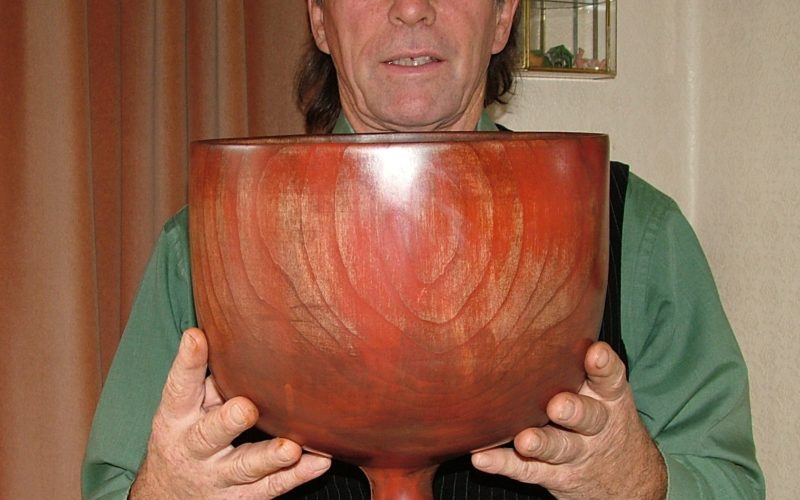
Making a Wassail Bowl
The height of wassailing could be said to have occurred during the 17th century, at a period when magnificent bowls elevated on a stemmed foot graced many a magnificent table. Wassail bowls were traditionally turned from Lignum Vitea, a newly discovered timber from South America. The function of a wassail bowl is to hold ‘wassail’, a hot punch like beverage of which there are many recipes, most will contain amongst other ingredients, Wine, Ale, Ginger, Apples, Honey and beaten egg whites. ‘Wassailing’, the tradition of drinking wassail took many forms.’ Wassail’ is a corruption of the Anglo-Saxon phrase waes hael, a term often used as a toast meaning, be hale or good health. Continue reading
Green wood inspiration: turning with wet wood
The ‘greenwoods’ of the Chiltern Hills have been a source of inspiration to me. I enjoy them in all seasons and all weathers, I’ve experienced the ever-changing ambiance that misty mornings or shafting sunlight can bring, and that mysterious period just after the sun has set. It’s from these greenwoods I’ve known from childhood that my raw material comes from. The Chiltern Forests are renowned for their Beech but it’s Sycamore, an interloper of recent centuries, that I use for much of my turned work. Not only is my timber from the ‘greenwood’ but I also turn it ‘green’ – working with ‘wet’ wood is both pleasurable and a challenge. Continue reading
The Chair Bodgers of Buckinghamshire
The old chair bodgers of Buckinghamshire are now relegated to history, the last few of them doggedly clinging on to their traditional way of life until the late 1950s. I have been privileged to know some of these craftsmen from the Beech-clad Chiltern Hills and have spent many a cosy hour by their firesides and in their disused workshops sharing their old tales and dry sense of humour. They are all gone now but their legacy is every where. You are supported by their craftsmanship every time you sit in an old Windsor chair. Every leg, spindle and stretcher contains the spirit of these men, the essence of the Beechwoods is still there and if those turnings could talk they would speak of spring Bluebells, red Squirrels and autumn winds. Continue reading
Cooking up colour: Stuart King’s turned wooden pots
Vessels come in all shapes and sizes and most lathe artists try to achieve a silhouette that first and foremost appeals to the eye. A beautiful form, balance, a pretty profile, outline is just one part of the whole.
Choice of material is usually of major importance. It must of course be fit for the intended purpose whether this is to exploit an example of highly figured grain or a plain wood that will allow the viewer to concentrate upon the form alone.
Finish is another consideration and to many this will mean polish to enhance some beautiful grain and to give a smooth surface.
The Bucklebury Bowl Turners
When things are commonplace they are often taken for granted but when the ‘everyday’ nears extinction we sit up, take notice and begin to realise the value of what has become unique. This was in some measure the story of George William Lailey (1869—1958), bowl turner of Bucklebury Common, Berkshire. Both George Lailey’s father and grand father (both named William) were bowl turners producing bowls of various sizes, plus a few platters, bread boards and handled scoops from the local Elm. Although Elm predominated occasionally other local timbers were used such as Chestnut, Sycamore and Beech. Continue reading
The Forgotten Turners of Kings Cliffe
The Doomsday Book records the Northhamptonshire hamlet of Clive (Kings Cliffe) as, ‘standing in 4 acres of meadow with a wood a mile long by half a mile broad’. In medieval times the village was one of the ‘Twelve Forrest Villages’ within the 250 sq. miles of Rockingham Forrest, originally owned by the crown and used exclusively for hunting.
One of the earliest recorded woodturners was Nicholas Baylye who married in 1597 and there has been an unbroken succession of Baylyes (Baly, Bailey) employed in woodturning right through to the 1940s. Continue reading
Spinning a Yarn: Eastern European bow lathe turners
Spinning of wool in the West has for a long time been the province of the machine, but in many parts of the globe including much of Eastern Europe this time-old activity is still very much a hand skill.
Some spinners use a spinning wheel while many more produce woollen thread with the aid of a drop spindle, simply a turned wooden tapering shaft about 16 inches long and about one inch diameter towards its base. They are sold at local markets and still form part of peasant culture. Continue reading