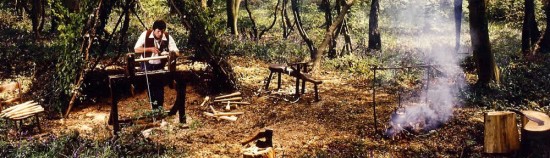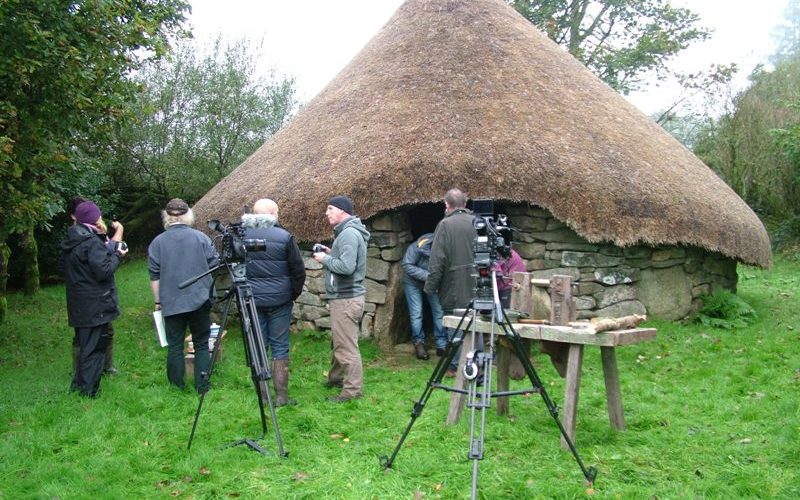
A Bronze Age burial chamber was discovered on Dartmoor, with the remains of a woman, and four lathe-turned ear studs. So began an archaeological experiment.
Lathe
Romanian bow lathe
In 1998 I was privileged to visit the Constantin family in Romania to film the making of drop spindles from lime wood (linden) on a primitive bow lathe.
Making a spinning top on a pole lathe
Robin Fawcett demonstrates how to make a spinning top on a pole lathe. An ash log is riven into quarters, using a maul and froe. It’s cut to length with a pull saw and shaped with a side axe, before being put in the pole lathe…
Turning wooden flowers on a lathe

Stuart King demonstrates how to turn wooden flowers on a lathe using simple tools.
Romanian pole lathe flask turner

Ion Constantin is the last of the Romanian pole lathe turners, turning traditional wood drinking flasks using techniques unchanged for at least 2000 years.
History of the Lathe: part one – reciprocal motion

All lathes by their very nature rely on a revolving work piece. To capture and impart this motion, to devise and create the required force has challenged mans ingenuity back into pre-history. Man has been using the momentum provided by a spinning weight for tens of thousands of years in the form of drop spindles […]
History of the Lathe: part two – continuous rotation
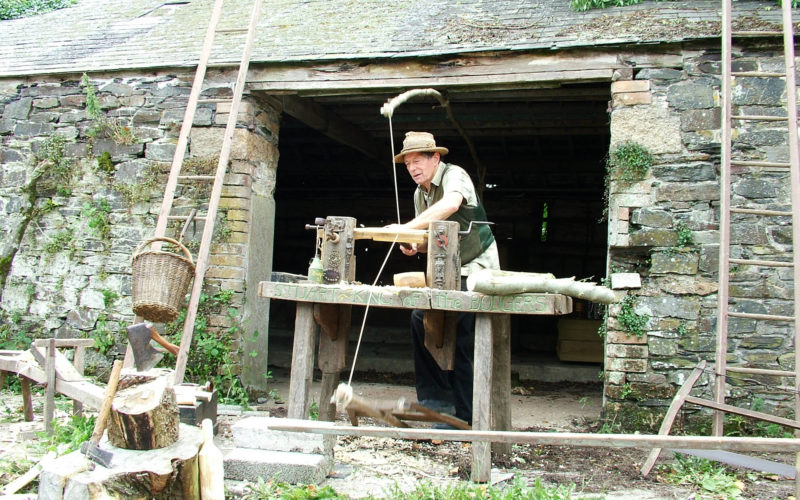
The wheel is probably man’s most important technological discovery. A Sumarian pictogram dated 3500BC is the earliest reference for the wheel. By 2000BC man was making spoked wheels yet the earliest pictorial reference we have of a wheel driven lathe seems to be from the 15th century.
History of the Lathe: part three – mechanical power
From classical times man has harnessed wind and water to work heavy machinery, to relieve him of hard physical labour and to speed up production. A Roman settlement C.200AD in southern France boasted sixteen water mills for grinding corn. It may be that this form of motive power was used to drive lathes also but […]
History of the Lathe: part four – the machine takes over
Man has always tried to find ways of making manual tasks easier and the businessman methods to reduce manpower, speed production and lower operating costs. A good illustration of this was the manufacture of rifle butts. Hand held firearms have existed since the Middle Ages and virtually all these weapons incorporated a hand fashioned wooden […]