The Wildwood Blog

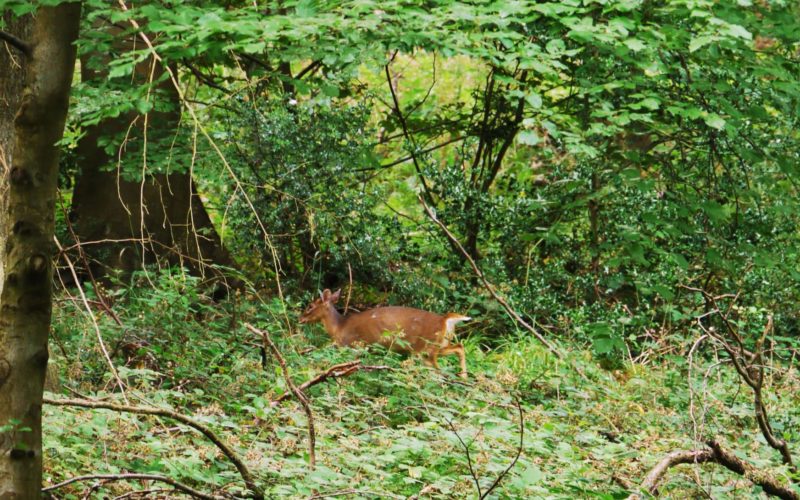
 Muntjac deer

The Wildwood Muntjac deer are often seen in daytime or heard close by barking loudly to others

 I have been acquainted with this secluded 42 acres since a teenager but it has only been the last few years that I have dug deep into it’s past as a armature woodland archaeologist and local historian.  Bluebelles

Foxgloves

Foxgloves apear in abundance for a couple of years after tree thinning having lain dormant for decades

Everywhere is to be seen the humps and bumps left by earlier inhabitants and I have set myself the task of making some sense of them.

 Wildwood

The Wildwood edge is defind by a medieval ‘woodbank’ and ditch

It is not just the visible landscape changes that bring me into contact with the ‘lost tribes’ of the Wildwood, but the tantalising artefacts lying on the woodland floor awaiting a keen eye to rediscover them. These objects range from fossils, Stone Age tools and discarded pottery sherds, discarded some thousands of years ago with no thought that someone far in the future would show even the slightest interest in them.

It will be my pleasure as the months roll by to share some of my discoveries with you, and you will be surprised at what has survived from the lives our enigmatic ancestors.

Tree Felling in the Wildwood

The woodmen are coming

Wildwood  - Stuart King- image March 2013 (3)

Good oak butts awaiting collection from the old drovers lane

Wildwood  - Stuart King- image March 2013 (2)

Firewood grade ash, the per ton value is measured by the loaded lorry

It is time to thin the trees, to bring down some of the giant oaks, beech and more recent ash to allow those that are left more elbow room. Continue reading

Stuart King on TV 2012

Alan Titchmarsh Show ITV

Stuart King on Alan Titchmarsh's ShowIt is good to see the media seemingly taking more interest in traditional crafts these days, let us hope this is a continuing trend.

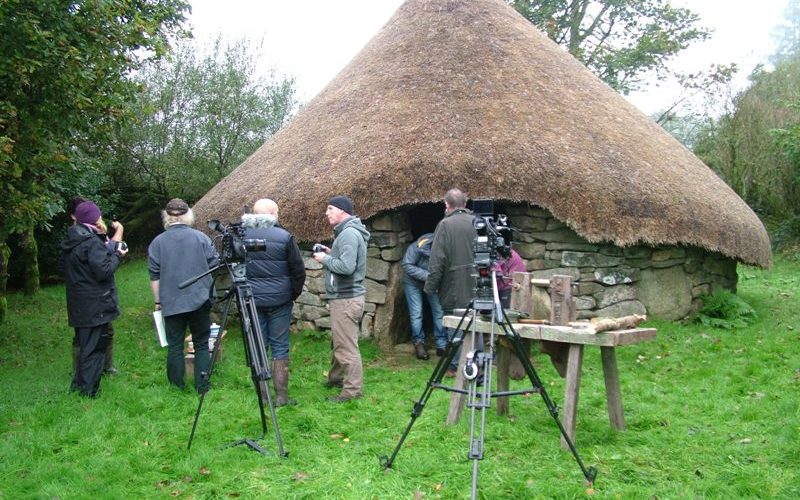
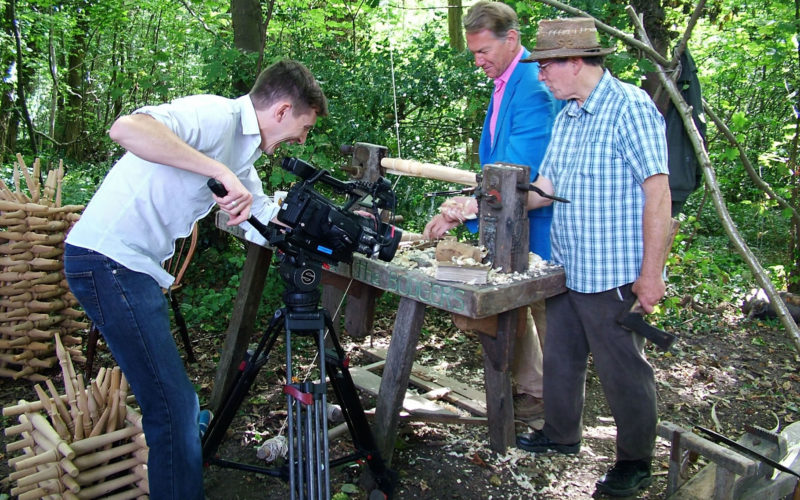
I was asked to contribute my expertise to three very different programmes in 2012; the first was the Alan Titchmarsh Show.  Being studio based meant an early morning trip to London to give the show host a lesson in woodturning on a power lathe. Continue reading

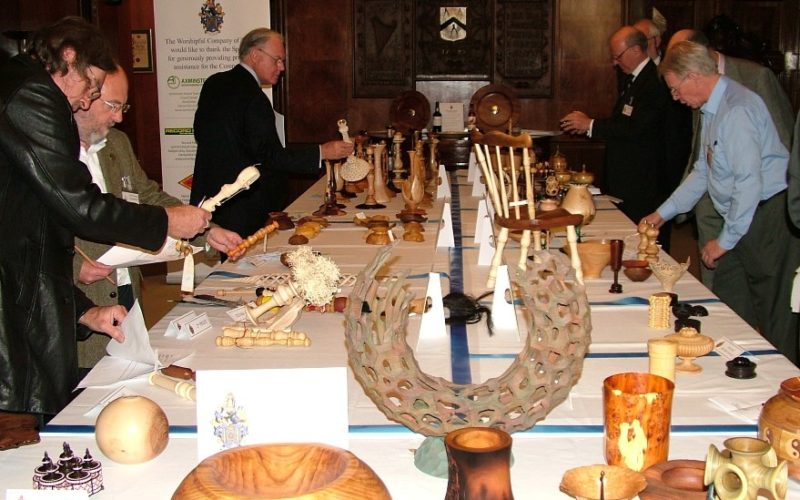
Wizardry in Wood, London Oct 2012

 Stuart King using his reconstruction of Leonardo da Vinci’s lathe  C1480.

Wizardry in Wood-2012 London-Dennis Hales image (4)

As a Freeman of the Worshipful Company of Turners it was my privilege to be in involved with organising the recent Wizardry in Wood exhibition at the Carpenters Hall, London.This event is held every four years and showcases the very best of British craftsmanship, historical, traditional and contemporary.


Wizardry in Wood 2012-Carpenters Hall-London (317)

Continue reading

History of the Lathe: part two – continuous rotation
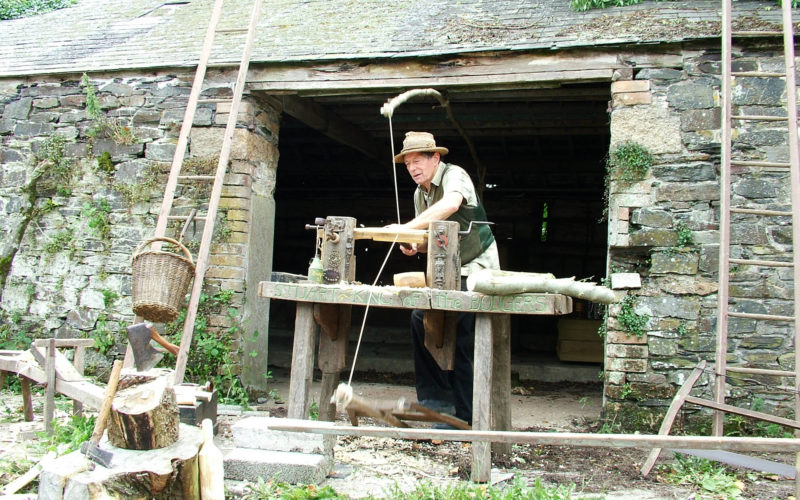
French giant wheel latheThe wheel is probably man’s most important technological discovery.  A Sumarian pictogram dated 3500BC is the earliest reference for the wheel. By 2000BC man was making spoked wheels yet the earliest pictorial reference we have of a wheel driven lathe seems to be from the 15th century.
The great advantage of a wheel driven lathe is that continuous and controlled rotary motion is possible. This was not an automatic benefit to every aspect of woodturning though, as is illustrated by the continuing use of the reciprocating bow, strap and pole lathes. These ancient, simple lathes could still compete and perform efficiently in certain specialist areas such as small spindle and bowl turning. Continue reading

History of the Lathe: part three – mechanical power

Electric power drillFrom classical times man has harnessed wind and water to work heavy machinery, to relieve him of hard physical labour and to speed up production. A Roman settlement C.200AD in southern France boasted sixteen water mills for grinding corn. It may be that this form of motive power was used to drive lathes also but if it was there seems to be no record of the fact. If this were the case, it would have probably have been the exception rather than the rule.

It does appear that the woodturners of old were content to continue with their tried and trusty traditional methods long after other sources of power were available to many of them. There were good economical reasons for this. No advantage was to be gained by expensive investment when the simple reliable technology of the strap, bow, pole and latter wheel lathes was usually just as efficient and more reliable. Continue reading

Raymond Harvey makes his (wooden) bed

Raymond Harvey, woodturner from High Wycombe

Raymond Harvey, woodworker from High Wycombe

“These are my most important tools”, said my host, looking at two home made knives, one ground from a worn-out hacksaw blade, and an old ‘Surform’ rasp. I was standing in Raymond Harvey’s makeshift back-garden workshop, which reflects his general approach to his work, being a structure consisting completely of recycled materials. There, standing majestic in the midst of this ramshackle shelter is the most stunning four poster bed I have ever seen.

It is bedecked, one could say almost bejewelled, with the most beautifully coloured and grained exotic woods, all vying for attention. These are arranged in very precise geometric patterns reminiscent of the Islamic art of the Moors. Continue reading